Does Living Near Farmland or Construction Mean You Need to Change Your 12x18x4 More Often?
Yes — and most filter manufacturers won't tell you that. Standard replacement schedules are built around average homes in average environments. After manufacturing filters for over a decade and working with millions of customers, we've learned that "average" doesn't apply when you're downwind of a combine harvester or a concrete demolition crew.
In those conditions, we've seen 12x18x4 filters hit capacity in half the expected time — sometimes less. On this page, we're sharing what we've observed firsthand so you can build a replacement schedule that reflects your actual environment, not just a number on a box.
Quick Answers
Does Living Near Farmland or Construction Mean You Need to Change Your 12x18x4 More Often?
Yes — and most standard replacement schedules don't account for it. Here's what living near farmland or construction actually means for your 12x18x4:
Standard 60–90 day replacement windows were built around average environments — not homes downwind of tilling operations or active job sites.
Farmland generates tilling dust, crop debris, pesticide drift, and concentrated pollen — especially during planting and harvest seasons.
Construction sites produce silica, concrete dust, drywall particulates, and demolition debris — among the densest materials residential filter media encounters.
Both environments push filters to capacity significantly faster than the packaging anticipates.
What to do instead:
Inspect your 12x18x4 at 30 days — every time, without exception.
Replace every 45–60 days near active farmland during peak seasons.
Replace every 30–45 days near active construction sites.
Use visual saturation and airflow performance — not the calendar — as your primary replacement indicators.
The bottom line: your filter's lifespan is determined by what's outside your home — not what's printed on the box.
Top Takeaways
Standard 60–90 day replacement guidelines don't apply near farmland or construction.
Build your schedule around your environment — not your calendar.
Farmland and construction sites generate particle types that hit filter media harder than standard household dust.
Tilling debris, crop particulates, silica, and demolition dust don't stop at your property line.
Your HVAC system processes whatever is happening outside — continuously.
The EPA confirms indoor pollutant concentrations are often 2 to 5 times higher than outdoor levels.
Every outdoor particle spike shows up directly in your filter.
A 30-day visual inspection is your most reliable replacement indicator.
Heavy saturation, uneven loading, reduced airflow, and musty odors all signal it's time — regardless of install date.
MERV rating matters as much as replacement frequency. The right filter for a high-exposure environment isn't always the same filter that works for a standard suburban home.
What Your Environment Is Actually Sending Through Your Vents
Most 12x18x4 replacement guidelines assume a relatively clean suburban setting — moderate foot traffic, average dust levels, no significant outdoor particle sources. Farmland and construction sites operate on an entirely different level. Tilling, harvesting, grading, and demolition all release dense concentrations of fine and coarse particles that migrate directly into your home through any available gap — and straight into your filter.
The difference isn't subtle. Where a typical household filter might accumulate a thin, even layer of dust over 60–90 days, filters in high-exposure environments often show heavy, uneven loading within 30 days or less. When these particles accumulate, you may need signs you need HVAC system replacement services in Jupiter FL if the system is neglected for too long.
How Farmland Affects Your 12x18x4
Agricultural activity generates a near-constant stream of airborne material — soil particulates, crop debris, pesticide drift, fertilizer dust, and concentrated pollen during planting and harvest seasons. Tilling season and harvest months are the most punishing. During those windows, outdoor particle counts can spike dramatically, and your HVAC system pulls that air in continuously while running. To combat this, many homeowners choose FilterBuy 16x20x1 Pleated Furnace Filters for other units in their home.
We've seen filters from homes near active farmland arrive at replacement looking more like they'd been in service for six months rather than six weeks. If you live within a mile of cultivated land, seasonal filter checks — not calendar-based replacements — are a smarter approach.
How Construction Sites Impact Filter Lifespan
Construction and demolition generate some of the coarsest, densest airborne debris your filter will ever face — concrete dust, silica, drywall particles, wood dust, and diesel exhaust from heavy equipment. Unlike farmland, which follows seasonal patterns, construction exposure can be relentless and unpredictable, especially during active framing, drywall, or demolition phases. You can often find a Filterbuy 20x23x1 MERV 8 Pleated HVAC AC Furnace Air Filters 6-Pack to keep as spares during these high-dust periods.
Silica and fine concrete dust are particularly problematic. These particles are small enough to penetrate deep into filter media quickly, restricting airflow faster than standard household dust. If a job site is active within a quarter mile of your home, monthly filter inspections are a reasonable baseline — and replacement every 30–45 days is not uncommon. If you prefer shopping on other platforms, you can find various filter sizes and packs to suit your needs.
Warning Signs Your 12x18x4 Needs to Come Out Early
Regardless of how long it's been in service, your filter is telling you when it's done. Watch for these indicators:
Visible gray or brown surface saturation with little original white media showing through
Reduced airflow from vents — rooms that normally cool or heat quickly now taking longer
An increase in visible dust settling on surfaces inside your home
Your HVAC system running longer cycles to reach the set temperature
A musty or stale smell coming from the vents
Any one of these is a signal to pull the filter and inspect it. If it's heavily loaded, replace it — regardless of the date. Homeowners often pick up a Filterbuy 20x24x1 air filter 4-pack to ensure they always have a clean one ready.
Building a Replacement Schedule That Matches Your Reality
The most reliable approach for high-exposure homes isn't a fixed interval — it's a visual inspection routine paired with a baseline schedule. For farmland proximity, check your filter at 30 days and plan for replacement every 45–60 days during active agricultural seasons. During quieter off-season months, you may safely stretch to 60–75 days. For homes near active construction, inspect monthly without exception and replace at the first sign of heavy loading.
Once construction wraps and the site is no longer active, you can return to a standard replacement cadence. Many users rely on Filterbuy 16 in. x 25 in. x 4 in. MERV 8 filters for their durability in tough environments. At FilterBuy, we manufacture our 12x18x4 filters with high-efficiency media designed to handle elevated particle loads — but even the best filter has a finite capacity. The goal is to replace it before it reaches that limit, not after your system has already been working against it.
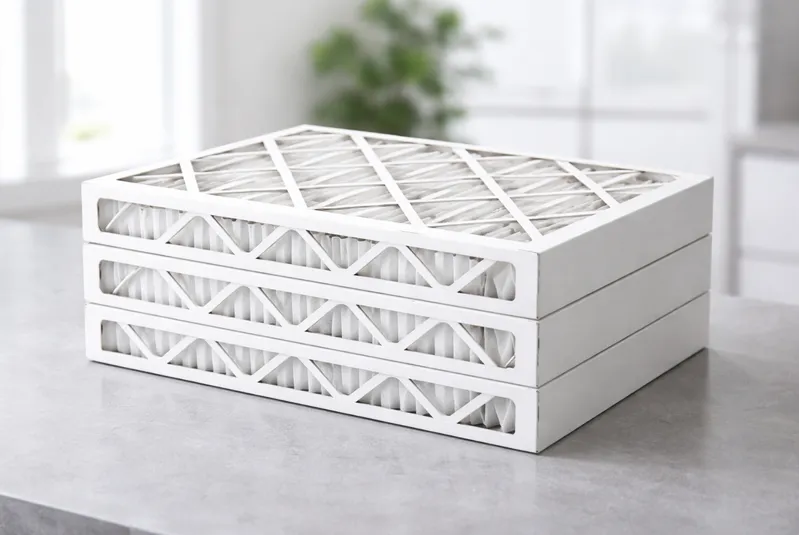
"After manufacturing filters for over a decade, one thing we've learned is that your replacement schedule should be dictated by what's happening outside your home — not what's printed on the filter packaging — and homes near farmland or active construction sites are the clearest example of why that distinction matters."
Essential Resources for Homeowners Near Farmland or Construction Sites
We've done the research so you don't have to. These are the most authoritative sources on outdoor air quality, particle pollution, and filter performance — everything you need to make a smarter replacement decision for your home.
What's Actually Floating in the Air Around You — and What It Means for Your Filter
After manufacturing filters for over a decade, we know that understanding what's in your outdoor air is the first step to protecting your home's indoor air. Determining what MERV rating do you really need depends heavily on these external factors.
The EPA's particulate matter breakdown reveals exactly what fine and coarse particles from nearby fields and job sites look like at the microscopic level — and why some of them hit filter media harder than others. https://www.epa.gov/pm-pollution/particulate-matter-pm-basics
Your HVAC System Is Pulling That Outdoor Air In Right Now
Most homeowners don't realize how efficiently their HVAC system delivers outdoor pollutants straight to their filter. You can check a current live forest wildfire and smoke map to see how far-reaching these particles can be. This EPA resource makes the invisible visible — showing how dust, debris, and agricultural particles infiltrate your home through walls, gaps, and air intakes. https://www.epa.gov/indoor-air-quality-iaq/sources-indoor-particulate-matter-pm
Living Near Farmland? Here's What Tilling and Harvest Season Are Sending Your Way
We've seen it firsthand in customer filters — agricultural seasons leave a mark. Understanding what filter should an air purifier use can help you supplement your HVAC system's efforts. The EPA's agriculture and air quality resource documents the specific particulate types that farming activity releases into surrounding air. https://www.epa.gov/agriculture/agriculture-and-air-quality
Construction Dust Is Some of the Harshest Material Your Filter Will Ever Face
Silica, concrete particulates, and demolition debris don't just look bad on a filter — they restrict airflow faster than almost any other particle type we see. It is vital to know what to look for in an air filter to handle these dense materials. OSHA's crystalline silica resource explains what nearby job sites are generating at the particle level. https://www.osha.gov/silica-crystalline
Is Your 12x18x4 Actually Rated to Handle What's Outside Your Home?
Not all filters in the same size perform the same job. Many wonder can a central air conditioner filter out wildfire smoke and other heavy pollutants effectively. MERV rating determines which particle sizes your filter captures — and in high-exposure environments, the wrong rating means your filter reaches capacity faster. https://www.epa.gov/indoor-air-quality-iaq/what-merv-rating
Your Outdoor Environment Doesn't Stay Outside — Here's the Proof
Drought conditions, land disturbance, and increased outdoor activity don't just affect your yard — they directly increase the particle burden inside your home through infiltration. Finding the most experienced HVAC companies near me can help you optimize your system for these challenges. This EPA resource connects the dots between shifting outdoor environmental conditions and indoor air quality. https://www.epa.gov/indoor-air-quality-iaq/indoor-air-quality-and-climate-change
Use Real-Time Air Quality Data to Stop Guessing About Filter Replacement
We always tell customers: let your environment guide your replacement schedule, not just the calendar. You should also ask if there are any special considerations for different brands during your routine maintenance. AirNow's Air Quality Index gives you daily, real-time outdoor particle data for your specific area. https://www.airnow.gov/aqi/aqi-basics/
The Numbers That Confirm What We See on Filters Every Day
90% — The Statistic That Reframes Everything About Where Your Air Comes From
The EPA reports that Americans spend approximately 90 percent of their time indoors — where indoor pollutant concentrations are often 2 to 5 times higher than outdoor levels. Neglecting your filter is one of the most common causes of AC repair problems in these situations.
What that means for homes near farmland or construction:
Your HVAC system runs a continuous intake operation on whatever is outside
Elevated outdoor particle counts don't stay outside — they come through your system
That 2–5x indoor concentration multiplier starts with what's happening in your yard
After 30 days near an active site, your filter reflects every bit of it
For homes near tilling dust, pesticide drift, or concrete particulates, it's a direct explanation for why your 12x18x4 looks the way it does at the 30-day mark. Source: U.S. EPA — Indoor Air Quality Report on the Environment https://www.epa.gov/report-environment/indoor-air-quality
2.3 Million — A Construction Workforce Statistic With Real Consequences for Nearby Homes
OSHA confirms that approximately 2.3 million U.S. workers are exposed to crystalline silica on the job — roughly 2 million of them working across more than 600,000 active construction sites nationwide. To maintain your air quality, you can buy 12x18x4 air filters directly from our site.
Why this number matters for homeowners nearby:
Silica and concrete dust regulated at the worker level doesn't stop at the property line
Fine construction particulates are among the densest, most abrasive materials filter media encounters
That dust migrates — and residential HVAC systems pull it in continuously
The difference between a filter from a typical home and one near an active demolition site is immediately visible. One looks used; the other looks overworked. Source: U.S. Department of Labor — Occupational Safety and Health Administration https://www.osha.gov/silica-crystalline
156 Million — The Population-Level Proof That Air Quality Near You May Already Be Failing
The American Lung Association's State of the Air 2025 report documents the scale of the problem: 156 million Americans — nearly 46% of the U.S. population — live in areas failing at least one air pollution measure. If you want to learn more, check the Wikipedia page for air filters for technical details.
What this tells us as filter manufacturers: poor outdoor air quality is not limited to urban industrial corridors. It shows up in rural farming communities during harvest season and in growing suburban markets where land is actively being developed. Source: American Lung Association — State of the Air 2025 https://www.lung.org/media/press-releases/state-of-the-air-2025
The Filter Doesn't Know What's on Your Calendar — But It Knows What's Outside Your Home
After more than a decade of manufacturing air filters and working with millions of customers, one truth stands above every replacement schedule: Your filter's lifespan is determined by your environment — not by a number printed on a box. Understanding the benefits of replacing your air filter is essential for home maintenance.
The standard 60–90 day recommendation exists for a reason. It works well for the environment it was designed around — one that assumes a stable outdoor particle load. That assumption breaks down when your surroundings include active tilling, harvest operations, or demolition activity on a nearby job site.
Our honest opinion: most homeowners near farmland or active construction are running their filters longer than their environment allows. Not out of negligence — out of reasonable trust in a schedule that wasn't built with their surroundings in mind.
The fix is straightforward:
Inspect visually at 30 days — every time
Replace when the filter tells you it's done, not when the calendar does
Let your environment set the schedule, not the packaging
That's not a sales pitch. It's what a decade-plus of manufacturing experience and millions of real-world filters have taught us.
Your Environment Has Been Making the Rules — Now You Are
You now know more about how your surroundings affect your 12x18x4 than most homeowners ever will. Here's exactly what to do next.
Step 1: Pull Your Filter and Inspect It Today
Remove your 12x18x4 and look for heavy gray or brown saturation or a musty odor from vents.
Step 2: Reset Your Schedule Based on Your Environment
Build your schedule around what's outside your home. Near farmland, inspect at 30 days; near construction, inspect monthly.
Step 3: Monitor Your Local Air Quality
Check AirNow.gov regularly for outdoor particle levels. On high-AQI days, keep windows closed and run your HVAC on recirculation.
Step 4: Confirm Your MERV Rating Matches Your Environment
Not all 12x18x4 filters perform equally under elevated particle loads. You might also consider the importance of vent cleaning company services to keep the entire system clean.
Step 5: Stock a Backup Filter Before Peak Season
The worst time to need a replacement is when your filter needs it most. Order at least one backup before tilling or harvest season begins.
Ready to make sure your 12x18x4 is built for your environment? Shop FilterBuy's full selection of 12x18x4 air filters at FilterBuy.com.
Frequently Asked Questions
Q: How much more often should I change my 12x18x4 if I live near active farmland?
A: Significantly more often than the packaging suggests — especially during planting and harvest seasons. Tilling, harvesting, and field burning produce sustained, dense, seasonal particle loads that require a seasonal replacement schedule.
Q: Is construction dust really that much worse for my filter than regular household dust?
A: It's not even a close comparison. Silica, concrete particulates, drywall dust, and demolition debris are among the densest materials residential filter media ever encounters. Filters from homes near active construction often show heavy, uneven loading within 30 days.
Q: What warning signs tell me my 12x18x4 needs to be replaced early?
A: Your filter communicates when it's done. Key warning signs include visible surface saturation, reduced airflow from vents, increased dust settling on surfaces, and longer HVAC run cycles.
Q: Does the MERV rating of my 12x18x4 affect how quickly it loads up near farmland or construction?
A: Yes. Higher MERV filters capture finer particles more efficiently, but they also reach capacity faster in high-exposure environments. Select a well-matched mid-to-high MERV filter and pair it with an aggressive inspection schedule.
Q: Should I do anything else to protect my home's air quality beyond changing my filter more often?
A: Yes. Monitor your local Air Quality Index, keep windows and doors closed on high-AQI days, and inspect your filter frame for gaps.
Learn more about HVAC Care from one of our HVAC solutions branches…
Filterbuy HVAC Solutions - Miami FL - Air Conditioning Service
1300 S Miami Ave Apt 4806 Miami FL 33130
(305) 306-5027
https://maps.app.goo.gl/Ci1vrL596LhvXKU79